System / 03
From competitor data to LinkedIn posts I can source
The briefI built a competitor-research and content workflow, then added guards for phantom changes, missing data and generated copy that drifted from the intended voice.
Problem and context
A team writing about a business banking product needed sourceable payment and banking comparisons. Early workflow versions invented claims when values were missing and flagged changes that were not real.
Those failures mattered more than generating more post ideas: a fluent brief could still contain an unsupported claim.
What I personally built
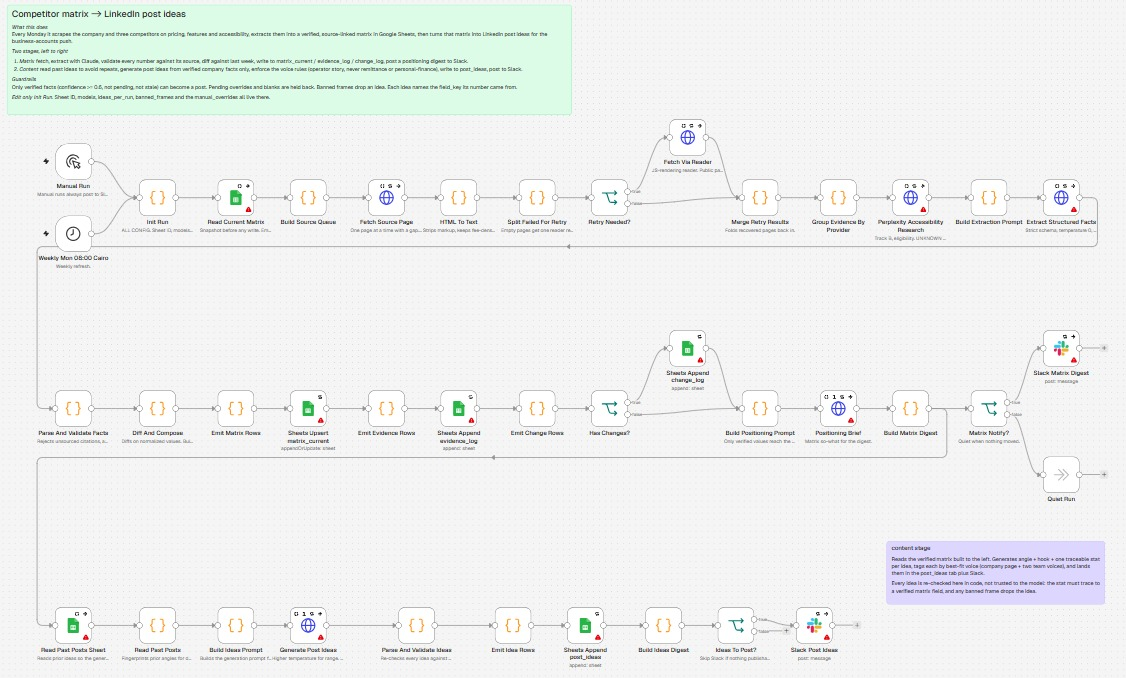
I built a competitor matrix and a content stage that produced post ideas with an angle, hook, one verified statistic, source URL and voice tag. I fixed phantom diffs, added a rendering-reader fallback for JavaScript-heavy pages, and kept blank fields distinct from suspicious values.
I added a pending flag so unconfirmed values could not reach the brief. I pre-filled nsave’s own feature details from an internal features document, and kept unconfirmed values pending. I enforced a voice guard in code rather than relying only on the prompt.
The first iteration was a 26-node matrix pipeline; the finished workflow is 42 nodes. These counts describe implementation, not quality or business impact. No workflow export is published here to independently count the nodes.
Architecture
- Competitor pages
- Extract source data
FallbackJavaScript-heavy page → use the rendering-reader fallback.
- Maintain a comparison matrix
Decision gateKeep blank and suspicious fields distinct; mark unconfirmed values as pending.
- Detect and inspect changes
- Generate a brief from confirmed values
Decision gatePending values → excluded before they reach the brief.
- Create sourced post ideas with a code-enforced voice guard
ReviewVoice rules are enforced in the workflow, not only requested in a prompt.
- Write outputs to Google Sheets and Slack
A final publishing or human-approval branch is not described here; the diagram does not imply one.
The decision and trade-off
I moved the controls into the workflow: pending flags constrain the input to generation, and the voice guard constrains the output. Excluding uncertain values can make a brief less complete, but preserves a visible gap instead of turning it into a confident claim.
Evidence and validation
Reported simulation. I tested the guards in simulation before use. Simulation cases, saved results, coverage and a measured success rate are not published here.
Historical estimate. I estimated approximately $0.35–0.70 per run for that workflow. This is not a guaranteed current price, a cost benchmark or an ROI claim; model choices, inputs and provider pricing affect it.
Provenance. Implementation and simulation are self-reported. Workflow exports, redacted before/after samples and saved simulation reports are not published here.
Limits and what I would test next
I would save cases covering nulls, stale sources, layout changes, rendering failures and false diffs; then inspect whether unsupported values can reach the generated brief. I would also test the voice guard on examples of drift and record current per-run cost on a defined input set. Publication-quality measurements, business results and conversions are not provided here.